

JESUS IS KING
On Kanye West, Pt. IX

“Reinstate the fear and love of God and eliminate the fear and love of everything else.”
—Kanye West, 2019.1
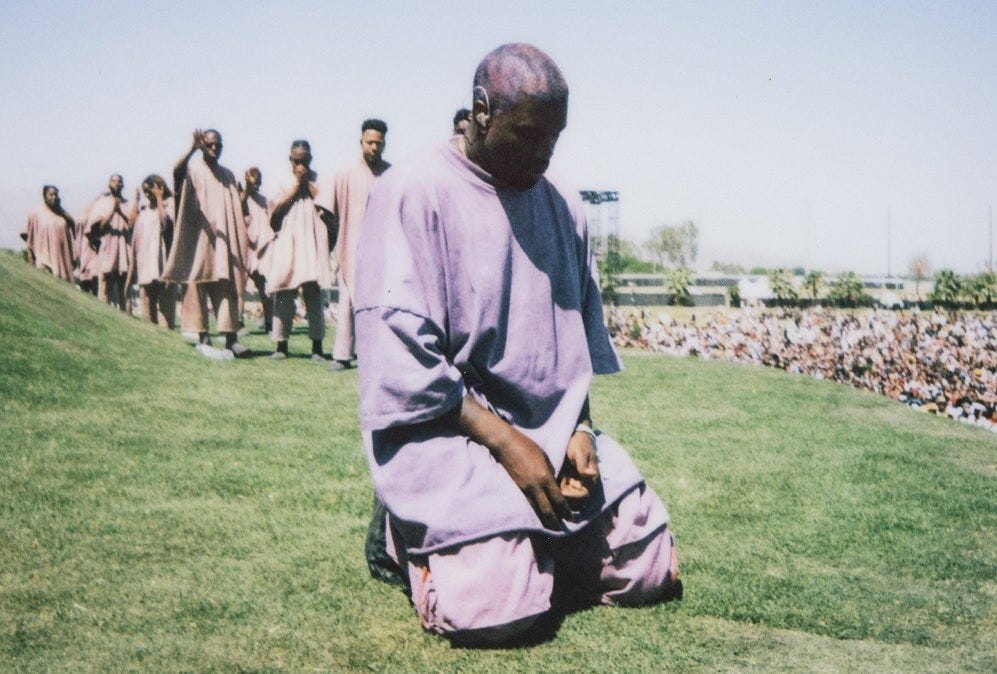
Amid the furore caused by Kanye’s support for Trump, his art mutated again. Kanye finally became the artist he had long wanted to be—a properly Christian rapper.
On 2004’s ‘Jesus Walks’, Kanye rapped of his hope to unify the club and the church. Aiming now to position himself as a right-wing, theocratic political candidate, he pursued this ambition wholeheartedly. ‘The greatest artist God ever created,’ he claimed, ‘is now working for him.’2 Kanye first founded the Sunday Service Choir, a communal music project where a crowd of gospel singers would perform Christian hymns and Kanye’s hits, rearranged into choral spectaculars. ‘Four months into Sunday Service,’ he said, ‘I gave my life to God.’3
The concerts sealed his transition to theological servitude and his music, once thematically religious, became properly religious art. No longer canvases for his ambivalence, Kanye’s songs became vessels for his religion and politics. The choir eventually released a record in late 2019, Jesus Is Born, where they performed pieces from the ‘future book of hymns’ envisioned for Kanye’s ‘Gospel University’.4
Before this, though, Kanye released his ninth solo album, Jesus Is King—one of his worst records to date. Earlier Kanye records, from The College Dropout and Twisted Fantasy to Yeezus and The Life of Pablo, rose to their great heights by playing with the tension between Kanye’s spirituality, ambition, and hedonistic desires. Each was a chiaroscuro of pain and pleasure, light and sin, whose power derived from the ambivalence and contradiction within him. Above all, they were earnest and sincere. On Jesus Is King, though, Kanye sought purity; he hoped to banish his darkness with the Lord’s light. ‘Nothing worse than a hypocrite,’ he raps on ‘Hands On.’ Abiding by this ethic, he excised everything from his art—the sexuality, the violence, the hedonism—that contradicted his Christian values. Profanity was prohibited on the record. Collaborators were asked to ‘fast and abstain from premarital sex’ to ensure that the album was pure. (At the time, Kanye also expressed a desire to censor his earlier records.)5 [v] Cleansed of darkness, his ambivalence disinfected, Kanye produced an album entirely without tension, its music ruined by a curious sense of dishonesty, bland sincerity, and a hollow, false purity. A purity desired, perhaps, because his psychic pain, guilt and ambivalence were too much to bear.
On Jesus Is King, faith never struggles against despair or temptation. There is neither contradiction nor reconciliation. Instead Jesus is King contained Kanye’s most shocking move yet: he became boring.
Kanye West opened the 2010s with the ambivalent nightmares of Twisted Fantasy and Yeezus. But by the decade’s end, this ambivalence was gone. Beneath the Lord’s light and unified with his ideals Kanye gained some stability; he also overflowed with unconvincing purity, righteousness, certainty and omnipotence. He had become a man who had tried to fix the tension between his egotism and self-hatred—his bipolarity, in a word—by genuflecting to God. And shortly after, he would pursue a theocratic, collectivist political campaign.
Footnotes
https://www.youtube.com/watch?v=z9dYenI2QOw at 16:25 – 16:32.
https://www.youtube.com/watch?v=z9dYenI2QOw
The Joe Rogan Experience, Episode #1554, at approx. 0:26:50
The Joe Rogan Experience, Episode #1554, at approx. 0:19:50
https://www.avclub.com/kanye-says-hes-re-recording-his-older-music-without-all-1839340484