

YEEZUS
On Kanye West, Part IV

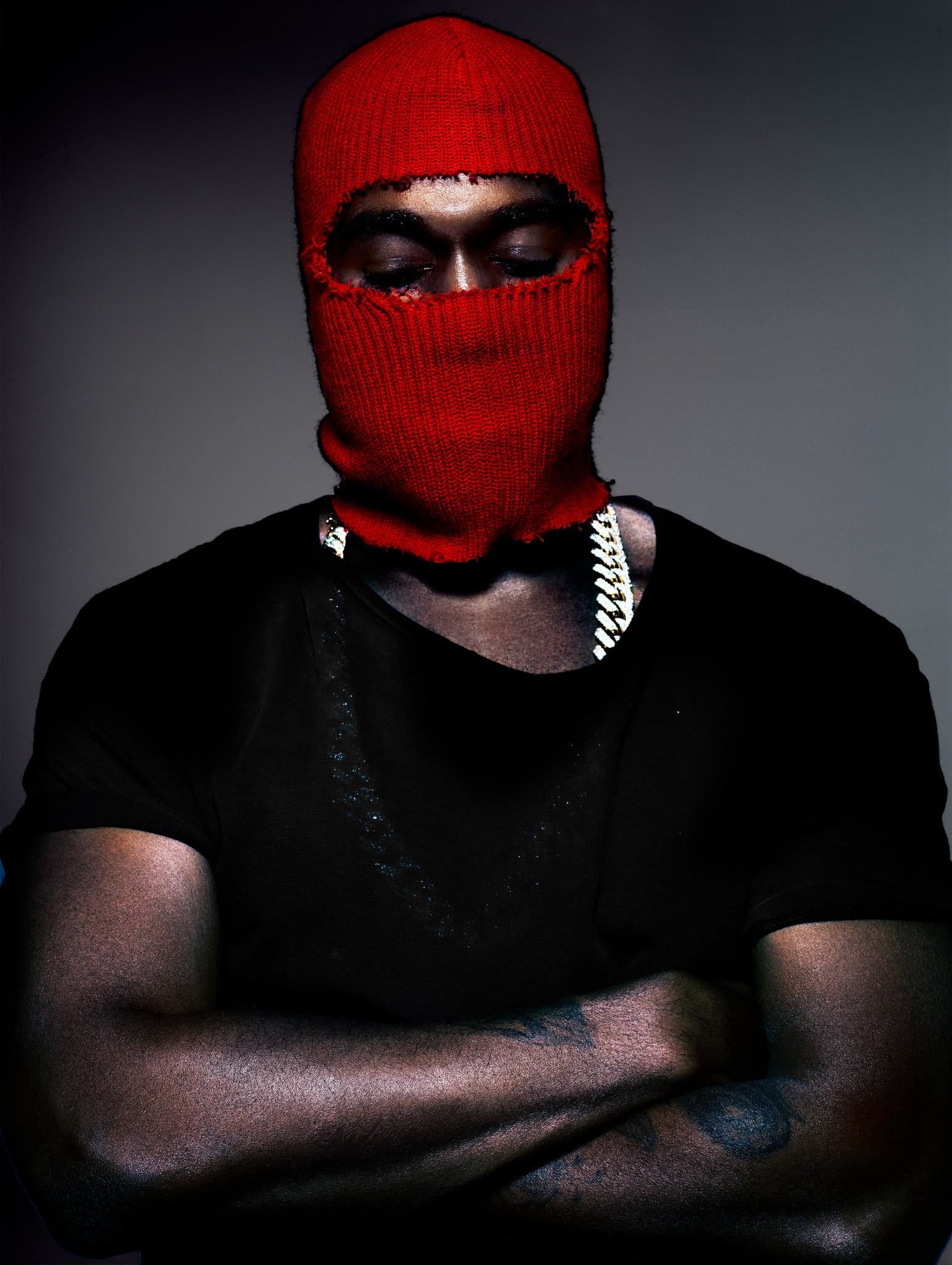
A gulf separates Kanye’s early works from 2013’s Yeezus – arguably, his best record. If ‘Touch the Sky’s was hip-hop’s prosperity gospel, Yeezus is rap’s Twilight of the Idols. Kanye becomes the anti-Christ on this record. But unlike Nietzsche, who nihilistically ripped at the Church, Kanye’s negative aggression aims at his world and himself. On Yeezus Kanye’s ambivalence exceeds Nietzsche’s. He performs as the titular character—a distorted, impure Jesus—to exalt and condemn contemporary celebrity’s lavish, awful pleasures.1
Disgust and lust abound on Yeezus. Kanye frequently revels in his god-corrupting, self-negating role. Aggressive joy animates his raps on opener ‘On Sight,’ a song chronicling his misogynistic sexual exploits. Patterning a savage electronic backtrack with ugly, hedonistic raps, Kanye spits: ‘How much do I not give a fuck? / Let me show you right now ‘fore I give it up.’ A ritenuto sample of a children’s choir singing God’s praise then interrupts the track. ‘He’ll give us what we need / It may not be what we want,’ the children sing. It’s a shocking, self-referential and grandiose move. At once, Kanye explains and justifies why he sacrificed his obsessive perfectionism and disrupts his own track. He demonstrates his power, too, and compares himself to God. It is a brilliant moment of self-harm and empowerment whose logic underlies every moment of Yeezus. The record insists Kanye’s self-deifying claims are believable, ridiculous, awesome and appalling, all at once.
Yeezus’ third track, ‘I Am a God (feat. God),’ deepens Kanye’s divine discontent. ‘This is what frustration fucking sounds like,’2 he once said of this song. Its first lines burn with narcissistic fury: ‘I am a God… Hurry up with my damn ménage / Get the Porsche out the damn garage!’ His opulence and authority established, he soon delivers some sacrilegious bars that link divinity to wealth: ‘I just talked to Jesus / He said, “What up Yeezus?” / I said, “Shit I’m chilling / Trying to stack these millions” / I know he the most high / But I am a close high… I am a God.’ On this track, Kanye repeats this self-deifying claim, ‘I am a God,’ with force and aggression. As on ‘Jesus Walks,’ theological ambivalence saturates each enunciation. He delivers the line with both revulsion and conviction. It soon becomes the track’s absurd, perverse truth. Necessary, yet unbelievable.
The heretical mantra of ‘I Am a God’ is a synecdoche for Yeezus’ underlying meaning. Yeezus shows the moment when the shadow enters the ideal and contaminates it. It is a record about how Kanye corrupted iconography by becoming an icon – when he ascended to Godhood.
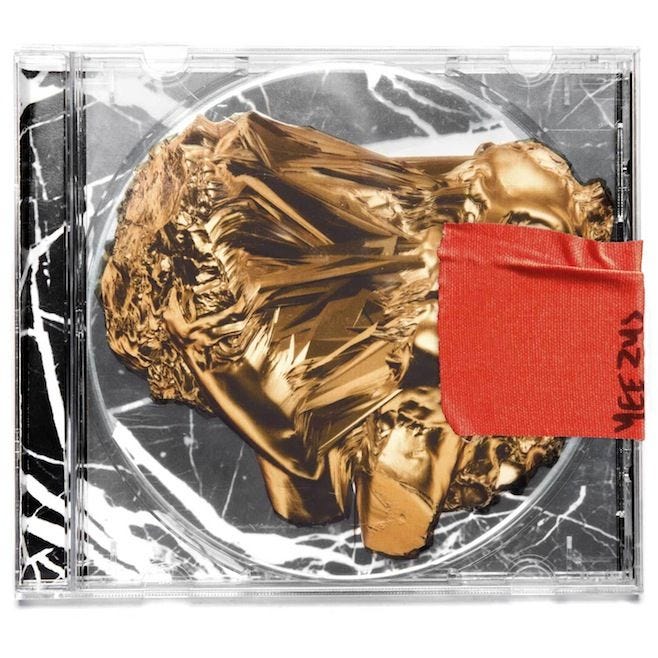
An alternative album cover for Yeezus made this theme of corrution and distorton explicit. Initially, Yeezus had a cover that featured a golden bust, twisted and melted. Upon release, he opted instead for a clear case with an unmarked disc – what he called an ‘open casket’ to the CD era.
Yet God, said Descartes, is a ‘supremely perfect Being.’3 Imperfection is not one of His qualities. By the track’s end, then, Kanye inevitably breaks his claim to godliness. The song’s first half holds Kanye’s most extreme claims of grandiosity. Yet its second half ends with the sound of him running and screaming. This scream admits several interpretations. Eruptions of the unconscious are always overdetermined. The artist himself also gives little away. ‘I’m going to scream in the middle of a track,’ Kanye said, ‘because that’s just how I feel.’4 But an obvious read is that Kanye is both expressing his frustration and running from himself. Furiously he reaches for perfection. Yet his aggression and narcissism finally frighten him. A wordless emulsion of rage, disgust, guilt, terror and awe, the scream express his fear-fetish of God’s immense powers. At the limit of his grandiosity, his narcissistic sublime, egotism suddenly becomes terrifying and taboo. Fury envelops him, too, because his godly ideals remain beyond his reach. Power fascinates Kanye. But his narcissism agonises, frightens and repels him. Searching for divine power, he discovers the terror beyond words buried inside his ideals. He both is, needs to be, and cannot be a God. The only possible response to this tension, it seems, is a scream.
Part of Kanye’s frustration on Yeezus, of course, comes from his experiences of racism—something I cover in my essay on Kanye’s Black Nazism. To be racialised and oppressed in White society—to be told, that is, that your very being is inferior for reasons beyond your control—is to bear a permanent, unhealable narcissistic wound. Much of Kanye’s early music responds to the narcissistic wounds American racism inflicts on Black subjects. Between the College Dropout and Graduation, he regularly dissects the experience of Black Americans under modern capitalism, animated by the hope that creativity, critique, insight and leadership can bring about a better future for racialised people. After all his success and brilliance, though, Kanye still found that his race limited his possibilities. On ‘New Slaves,’ he raps of the depressing, infuriating fact that he now just experiences ‘rich n***a racism’ instead of ‘poor n***a racism.’ The fashion industry’s refusal to take him seriously as a designer also makes him feel ‘they wasn’t satisfied unless I picked the cotton myself.’ His ambitions frustrated by racism, Kanye’s fury burns all across Yeezus, an album filled with rage towards racist social structures and attitudes that confine him and other Black people. In Black Skinhead, author Brandi Collins-Dexter argues that this frustration may have revealed to Kanye that the American Dream is a lie, turning him away from liberal, Democrat politicsand towards the political right. Meanwhile, as Sha’Dawn Battle argues in The Cultural Impact of Kanye West, a typically masculine response to the narcissistic wounds of frustration and racism is also hypermasculinity and misogyny, which is perhaps why ‘On Sight,’ ‘New Slaves’ and ‘I’m In It’ contain some of the most extreme expressions of militancy and misogyny in Kanye’s discography.
On Yeezus Kanye contaminates and penetrates the good with evil. Embracing a demonic, negative perfection he reveals what hellfire burns behind life’s highlights. ‘I Am a God’ is therefore a photo negative of ‘Touch the Sky.’ The earlier song sees Kanye blissfully identified with his ideals. The latter shows him lust for the shadows cast by his highest values. Once proud of his immense talents, here Kanye fears and desires his dark narcissism. Unlike ‘Jesus Walks,’ though, Kanye cannot synthesise his ambivalence. Reconciliation is impossible. Irreparably seduced and repelled by the egotistic, he instead inhabits a bipolar world and pushes his contradictions to their limits. In the chaos and collapse of Yeezus, a world of artifice on the brink of disintegration, Kanye finds intense discomfort and dark pleasure. The tension he created left us with his most fascinating record.
→ Part V
Kanye’s verse on ‘No Church in the Wild’ foreshadows his position on Yeezus to some extent, a verse where he positions hedonism as a response to nihilism and godlessness and highlights the pain of doing so. See Julius Bailey’s ‘When Apollo and Dionysus Clash: A Nietzschean Perspective on the Works of Kanye West,’ in The Cultural Impact of Kanye West, pp.149-165.
Kanye West: God & Monster, p.329.
Meditations on First Philosophy, p.18.
Kanye West: God & Monster, p.329.